When 'Honor Your Elders' Becomes a Cage: Rethinking a Cultural Rule That Was Never Meant to Hurt Us
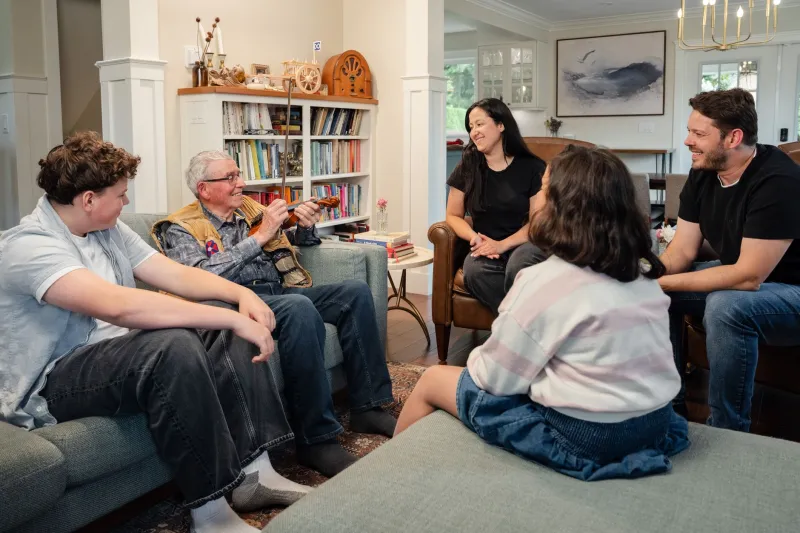
There's a particular kind of silence that Asian Americans know well. It happens mid-sentence, right before you're about to say something true. Your grandmother is giving advice that's twenty years out of date, or your uncle is making a comment that would be called out in any other room, and you open your mouth — and then you don't. Because somewhere in the back of your head, a voice says: they're your elder. Show respect.
Most of us were raised on some version of this rule. In Chinese culture, it's rooted in Confucian thought — xiào, or filial piety, the idea that honoring those who came before you is a moral cornerstone of a good life. Korean, Vietnamese, Filipino, Japanese, South Asian traditions all have their own versions of the same principle. Respect your elders. Defer to experience. Don't embarrass the family.
And honestly? There's real wisdom there. Elders carry knowledge that doesn't fit in a Google search. They've survived things we can't fully imagine. In many cases, their guidance has kept families intact across generations and across oceans.
But here's the thing nobody says out loud: wisdom and harm are not mutually exclusive. And a cultural value, no matter how ancient or well-intentioned, can be used as a weapon.
The Rule That Silences You
Maya, a 29-year-old Korean American from Chicago, remembers the exact moment she understood this. She was 22, newly out as bisexual, and her grandmother had said something cutting at a family dinner — a comment dressed up as concern, the kind that lands like a slap but leaves no mark. When Maya tried to respond, her mother gave her a look that could stop traffic. Later, in the kitchen, the message was delivered plainly: She's old. She doesn't understand. Just let it go.
"I let it go for about six more years," Maya told me. "And every time I let it go, I got a little smaller. I started dreading family events. I started dreading her. And I kept being told that was my problem to fix, not hers."
This is the mechanism. The rule of respecting elders, in its weaponized form, operates by making the person being harmed responsible for managing the relationship. It frames silence as virtue and pushback as disgrace. It turns your legitimate emotional response into a character flaw.
And it works so well precisely because it's wrapped in something real — in genuine cultural meaning, in love, in the weight of everything your family sacrificed to get here.
Outdated Advice Isn't Neutral
Sometimes it's not even about overt harm. Sometimes it's subtler: an elder giving advice that's simply wrong for the world you're actually living in, and the cultural expectation that you'll nod and comply.
For Kevin, a second-generation Vietnamese American in Houston, it was career pressure. His father — who had rebuilt his life from nothing after coming to the US as a refugee — had very specific ideas about what a stable, respectable career looked like. Kevin's interest in UX design was met with years of gentle dismissal, then not-so-gentle insistence that he pursue accounting or medicine. "My dad had survived actual war," Kevin said. "How do you argue with that? How do you say 'I know better than you' to someone who lost everything and still built a life?'"
He didn't argue. He spent three years in a pre-med track before a therapist helped him name what was happening: he was confusing his father's authority with his father's accuracy. The two are not the same thing. His father's suffering was real. His father's wisdom about survival was earned. But his father's understanding of the 2020s American job market was, frankly, limited — and no amount of sacrifice changes that.
Respect doesn't require pretending someone knows something they don't.
The Generational Trauma Loop
Here's what makes this especially complicated: a lot of the harmful behaviors that elders pass down aren't malicious. They're traumatized. The parent who controls through criticism was probably criticized into submission themselves. The grandparent who dismisses mental health struggles probably survived circumstances where there was no room for anything but forward motion.
Understanding that context matters. It genuinely does. But understanding why someone causes harm is not the same as accepting that harm as your inheritance.
Dr. Jenny Wang, a Taiwanese American psychologist and author of Permission to Come Home, has written extensively about this tension. The goal, she argues, isn't to stop loving your elders or to erase cultural values — it's to stop confusing love with compliance. You can hold compassion for what someone survived and refuse to let their unprocessed wounds become your problem to absorb in silence.
That reframe — compassion without compliance — is quietly radical in a lot of Asian American families. Because the cultural script doesn't usually include a middle option. It's either full deference or full disrespect. There's rarely language for: I love you and I'm not going to let you do this to me.
Breaking the Rule Isn't Betrayal
Jasmine, a 34-year-old Filipino American in Los Angeles, spent most of her twenties in a cycle of conflict and guilt with her mother over everything from her career choices to her relationship with food to the way she chose to grieve her father's death. Every attempt to set a boundary was reframed by her extended family as disrespect. She was too American. She had forgotten where she came from.
"I heard that so many times," she said. "Like asserting myself was a form of cultural erasure. As if the only way to be authentically Filipino was to keep my mouth shut."
What Jasmine eventually found — through therapy, through community, through a lot of painful conversations — was that her culture had actually given her more than just the rule of deference. It had given her bayanihan, the value of communal care. It had given her a deep sense of family loyalty. It had given her resilience and warmth and a table that was always full. She didn't have to throw all of that out to stop accepting harm.
She got to keep what was good. She got to put down what was hurting her.
A Different Kind of Respect
Maybe that's the reframe we actually need. Not respect your elders as an unconditional rule, but respect as something that flows in multiple directions. Something that includes honesty. Something that makes room for younger generations to say: this part of what we inherited isn't working, and we're going to do it differently.
That's not a rejection of culture. In a lot of ways, it's the most culturally alive thing you can do — taking something living and letting it grow instead of keeping it preserved in amber because changing it feels like losing it.
Your elders, at their best, didn't survive everything they survived so you could stay small and silent. They did it so you could have options they never had. Exercising those options — including the option to push back, to protect yourself, to tell the truth — might actually be the deepest form of honoring what they built.
Even if it doesn't look like respect from the outside.
Even if it's the loudest thing you've ever done.