When 'You Have Your Family' Just Isn't Enough: Asian Americans Building Community From Scratch
There's a particular kind of loneliness that doesn't get talked about much in mainstream conversations about mental health. It's not the loneliness of someone who has no one. It's the loneliness of someone who technically has people — parents, cousins, maybe a sprawling group chat full of relatives — but still goes to bed at night feeling profoundly unseen.
For a lot of Asian Americans, that's the specific flavor of isolation we're living with.
The cultural script we inherited goes something like this: family is everything. Family is your safety net, your social life, your identity. And look, there's real beauty in that tradition. But when the script doesn't match your actual life — when your family doesn't understand your career choices, your sexuality, your mental health struggles, or just you — the gap between what's supposed to be and what actually is can feel enormous.
And the wider culture isn't exactly rushing to acknowledge it. The model minority myth has a sneaky little corollary: the assumption that Asian Americans are fine, actually. That we have strong family values and community structures that cushion us from the kinds of social disconnection plaguing other demographics. Researchers and public health officials have spent years sounding alarms about a loneliness epidemic in the US, but Asian American experiences of isolation rarely make it into that conversation.
So a lot of us are quietly, intentionally, building something new.
The Myth of the Built-In Support System
Let's name the assumption directly: Asian Americans are often treated as immune to loneliness because we supposedly have tight-knit families and ethnic communities to plug into. And for some people, that's genuinely true. But it's also a stereotype that flattens an incredibly diverse population — and it ignores the reality that family can be a source of stress, not just support.
Second and third-generation Asian Americans in particular often find themselves caught between worlds. Too Americanized for some family members, too Asian for mainstream spaces. The emotional labor of navigating that in-between place is exhausting, and it frequently happens without adequate support.
Add in the reality that many Asian American families don't talk openly about mental health, conflict, or emotional needs — and you've got a recipe for profound disconnection, even when you're surrounded by people.
Michelle, a 29-year-old Korean American living in Chicago, described it this way: "I grew up in a house with four people and felt completely alone. We didn't talk about feelings. We talked about grades and food and whether I'd called my grandparents. I love my family, but I didn't learn what real emotional intimacy felt like until I was in my mid-twenties, building friendships as an adult."
Chosen Family Isn't Just an LGBTQ+ Concept Anymore
The language of "chosen family" has historically been centered in LGBTQ+ communities, where it emerged as a survival strategy when biological families rejected queer people outright. But the concept is expanding — and Asian Americans are increasingly claiming it.
For those whose family relationships are strained, distant, or simply insufficient, the intentional construction of close friendships and community networks isn't a backup plan. It's the plan.
This looks different for everyone. For some, it's a tight group of friends who show up for the unglamorous stuff — the 2 a.m. anxiety spirals, the career pivots, the breakups. For others, it's finding community through creative spaces, activist organizations, or diaspora-specific groups that offer something biological family often can't: the experience of being fully known.
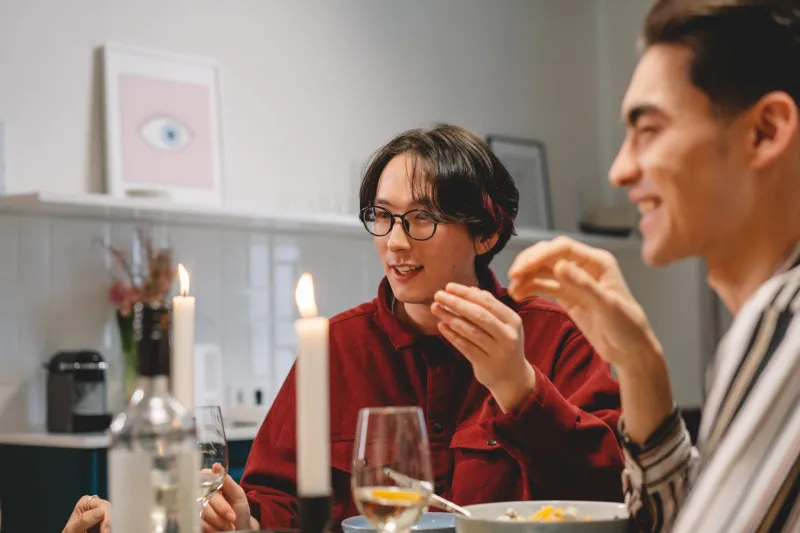
Jason, a 34-year-old Filipino American in Los Angeles, started a small dinner group a few years ago specifically for second-gen Asian Americans who felt disconnected from both their heritage communities and mainstream American culture. "We called it a dinner club but it was really just an excuse to have real conversations," he said. "We'd talk about our parents, about identity, about feeling like we didn't belong anywhere. It became the most important community in my life."
Mentorship Networks and the Filling of Invisible Gaps
One specific place chosen community is showing up is in mentorship — both formal and informal. Asian Americans who lacked professional or personal mentors growing up are now actively creating the networks they wish they'd had.
Organizations like Asian American Pacific Islander (AAPI) professional networks, creative collectives, and even informal Slack groups and Discord servers have become spaces where people find not just career guidance but genuine belonging. The mentorship happening in these spaces often goes way beyond professional advice — it's people sharing their experiences with family pressure, with racism in the workplace, with the particular exhaustion of code-switching constantly.
This kind of peer mentorship is doing something that traditional community structures — temples, cultural associations, family networks — sometimes struggle to do: it's meeting people where they actually are, not where the community thinks they should be.
The Psychological Cost of Pretending You're Fine
Here's what doesn't get said enough: performing okayness is genuinely exhausting. And Asian Americans have been socialized to perform okayness at an Olympic level.
When you've grown up in a culture that frames emotional vulnerability as weakness or burden, asking for help — let alone admitting you're lonely — feels almost impossible. You internalize the idea that your struggles are minor compared to what your parents or grandparents went through. You tell yourself you're fine. You stay busy.
But loneliness that goes unnamed doesn't go away. Research consistently shows that chronic social isolation has serious consequences for mental and physical health — increased rates of depression, anxiety, even cardiovascular disease. And because Asian Americans are statistically less likely to seek mental health treatment, the toll often goes unaddressed for years.
Building chosen community is, in this context, genuinely a health intervention. It's not soft or supplementary. It's necessary.
What It Actually Looks Like to Build This
If you're in that place of recognizing the gap between the community you were supposed to have and the one you actually have, the path forward is less dramatic than it might sound. It starts with honesty — with yourself, and eventually with others.
It means showing up consistently for people, even when that's inconvenient. It means being willing to be the one who says "I'm struggling" first, creating the opening for others to do the same. It means seeking out spaces — online or in person — specifically built for the kind of conversations your family of origin couldn't have.
It also means letting go of the guilt. The idea that building community outside your family is somehow a betrayal, or a sign that you've failed at being a good Asian kid, is a lie worth dismantling. You can love your family and also need more than they can give you. Those things aren't in conflict.
The loneliness epidemic is real, and it's touching Asian American lives in ways that aren't being adequately seen or studied. But the response being built — quietly, intentionally, one dinner club and mentorship call and honest conversation at a time — is something worth paying attention to.
We're not waiting to be included in someone else's community anymore. We're building our own.