Nobody Warns You That Falling in Love Is a Group Project (When You're Asian American)
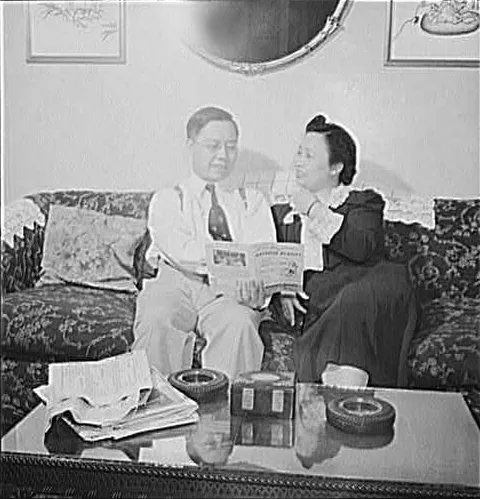
Photo: Marjory Collins, Public domain, via Wikimedia Commons
My white friend once told me, sincerely, that dating me "must be so nice because there's no drama in Asian families." I let that sit for a second. Then I told her about the time my aunt ran a background check — via church connections — on a guy I'd mentioned once, in passing, at a funeral.
She has since apologized. The aunt has not.
The App Tax
Let's start with the digital gauntlet, because that's where most of us meet people now. If you're an Asian woman on the dating apps, you've seen it: the bio that mentions "no drama, I love sushi and anime," the opener that's just "konichiwa," the guy who wants you to know he "did a semester abroad in Seoul, so he basically gets it."
Fetishization gets discussed in think pieces, but less attention goes to how exhausting it is in practice. It's not always aggressive. Sometimes it's just the low hum of being treated as a category instead of a person — an experience, a bucket-list item, a walking anime recommendation engine. You spend the first three dates running a background check of your own: Does he like me or does he like the idea of me? There's no text field for that on Hinge.
Asian men get the inverse problem — the racist desexualization that's been documented to death in OKCupid's old data and every casting call since. Different flavor, same insult: neither group gets to just be a person on a date.
The Diplomatic Briefing
Then there's the other end: bringing someone home. This is not a casual event. This is a summit.
Before my now-husband met my parents, I prepped him like he was about to testify before Congress. Here's the protocol: bring fruit — good fruit, not gas station fruit. Compliment the cooking and then accept seconds, no, thirds. Do not refuse anything. Do not ask personal questions of my father; he will ask them of you, eventually, in his own time, possibly in code. If my mother says "he's so dark, he needs to eat more," that is a compliment. I cannot explain the mechanics. It just is.
And here's the part that doesn't make it into the rom-coms: you're not just introducing a partner. You're introducing a hypothesis. Your parents are running projections — will this person understand us, will they let you keep your language, will our grandchildren know what tangyuan is? You're not dating for two anymore. You're dating for a whole diasporic lineage.
The Conversations We're Not Having at Dinner
The title of this piece isn't a joke. There are entire archives of Asian American dating stories that never reach immigrant parents' ears. The fetishizer we laughed off on a second date. The white partner's family who made a "me love you long time" joke at Thanksgiving and got a tight smile. The way some of us hid relationships for years because we knew the reaction to dating outside the community — or inside the wrong part of it — would detonate the household.
And look, things are shifting. Younger Asian American parents are often more flexible. Shows like Beef and Past Lives put our romantic interior lives on screen with actual nuance, and it turns out audiences will watch us be complicated humans. Imagine that.
But the silence at the family dinner table has a cost. When we don't tell our parents about the racism we navigate in dating, they can't understand why we're tired. When we don't tell our kids about the pressures we felt, they think their struggles are personal failures instead of structural weather.
What I'd Tell My Younger Self
You are allowed to want a partner who is attracted to you specifically — not to your ethnicity, not to a fantasy, not to their study abroad semester. You are allowed to be with someone your family needs time to understand. You are allowed to be the person who finally says, at the dinner table, "Actually, let me tell you what dating is like for me."
That last one is the hardest. But I've watched it change things. My cousin said it out loud once, over hot pot, and my uncle — a man of approximately forty words per year — put down his chopsticks and said, "That sounds very tiring."
It was the most romantic thing anyone in my family has ever said about love. Because it was the first time someone acknowledged the whole picture.
Dating while Asian American isn't a private struggle. It never was. It's time we started telling each other the stories — even the ones that never make it past the kitchen table.